
Review · USA
Rockies to the Red Rocks Train Denver to Moab SilverLeaf
The best part of this trip is simple: you reach parts of the Colorado River corridor that are hard to see from the highway. From Denver, the train climbs toward the Continental Divide, slips through the Moffat Tunnel, then follows cliffs and river bends toward Moab. Gore Canyon and the red rock approach to Arches National Park are the visual high points.
I especially like two things here. First, you can watch the scenery without driving, navigating, or squeezing into a roadside pullout. Second, the service is unusually hands-on: meals and drinks come to your seat, Hosts explain the route, and your luggage is transferred to and from the Glenwood Springs hotel. The main drawback is price. At $1,723 per person, this is a special-occasion rail journey, not a cheap way to get from Colorado to Utah.
Key points to know before booking
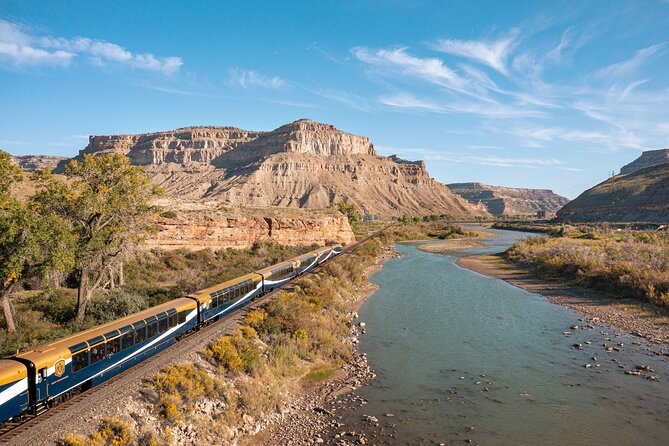
- The train follows the Colorado River: Much of the route passes through narrow canyons and rough country that cars cannot easily reach.
- Glenwood Springs breaks up the trip: You spend one night in this historic spa town instead of sitting on the train for one very long day.
- SilverLeaf puts service at your seat: Breakfast, lunch, snacks, and drinks are part of the onboard experience, with restroom access and friendly Hosts.
- The scenery changes fast: Expect mountain forests, high passes, river canyons, red sandstone walls, desert mesas, and views toward the La Sal Mountains.
- The best narration matters: Hosts such as Joey, Olivia, Paul, Jessica, Mike, and Rae have been praised for route stories, local facts, and attentive care.
- This is a scenic rail trip, not a park tour: You pass by Arches National Park near Moab, but the train does not provide a full visit to the park.
Why the Denver to Moab route feels different
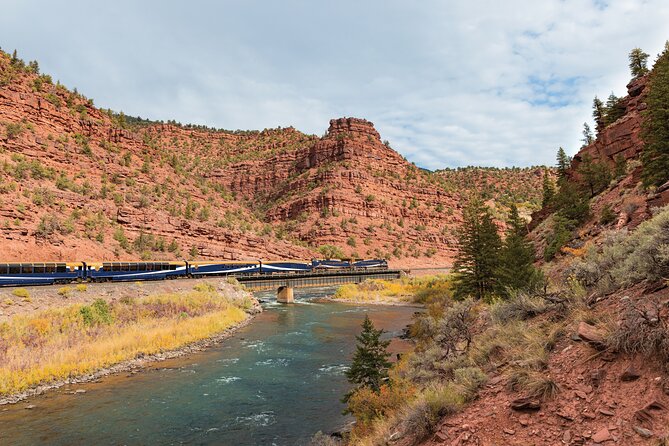
Many journeys between Denver and Moab are highway trips. You spend much of the time watching traffic, checking directions, and searching for safe places to stop. This train takes a slower route beside the Colorado River, where steep rock walls and water-level views unfold right outside the window.
That change in pace is the real value. You can settle into your seat, order a drink, listen to the Host, and keep watching the view without worrying about the next turn. The route also gives you a useful visual lesson in the geography of the West. Colorado begins with mountains and snow-fed rivers. By the time you reach Utah, the mountains have given way to mesas, sandstone cliffs, and open desert.
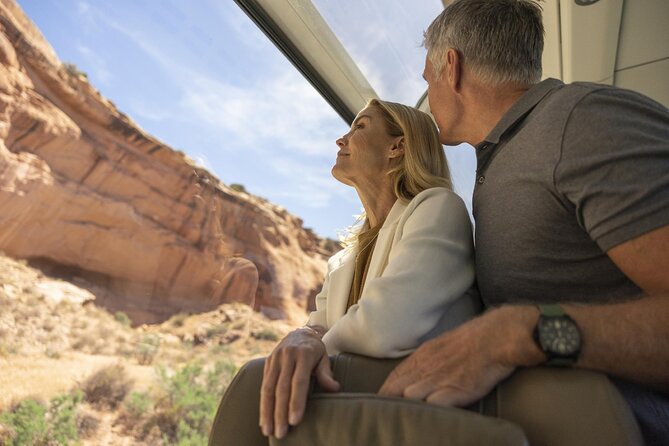
The train is designed around sightseeing. The cars have large dome windows, and the service keeps food and drinks coming without requiring you to leave your seat. SilverLeaf is the standard level. SilverLeaf Plus adds a lounge car, extra room to relax, a small outdoor viewing area, wine pairings, premium alcoholic drinks, and signature cocktails. If you care most about a little more space and a chance to step outside, SilverLeaf Plus may be worth comparing. If you mainly want clear views and full meal service, standard SilverLeaf covers the essentials.
More Train Journeys around the USA:
- Key West Conch Tour Train
★ 4.5 · 792 reviews - Skunk Train: Pudding Creek Express from Fort Bragg
★ 4.0 · 260 reviews - Skunk Train: Wolf Tree Turn from Willits
★ 4.5 · 258 reviews
Day one: leaving Denver and climbing into the Rockies
Your morning begins in Denver, with an 8:30 a.m. start listed for the experience. Before the train portion, a motorcoach transfer passes through the River North Art District, known locally as RiNo. Colorful murals and creative businesses give you a quick look at a changing Denver neighborhood before the route heads toward the mountains.
The city soon gives way to the foothills. The train works through the Big 10 Curve, a striking piece of railroad engineering. The tight 10-degree curves add track mileage so the grade stays manageable for the train. This is the sort of detail that makes the route more interesting than a series of pretty views. You see the practical choices that made rail travel through the Rockies possible.
As the train gains height, look toward Boulder and the Flatirons. Boulder sits where the Rocky Mountains meet the Plains, and the famous slab-like rock formations are easy to recognize when conditions are clear. You also pass Gross Reservoir Dam, which supplies water to Denver and the agricultural Plains.
Breakfast and lunch are served with a locally inspired menu, and snacks and drinks are available through the day. The food is not an afterthought here. Several people singled out the meals as attractive and well prepared, with some calling the dishes photo-worthy. That matters because the first day runs for roughly four hours before the overnight stop, and a proper meal makes the train feel like the main event rather than simple transportation.
Through the Moffat Tunnel and across the Continental Divide
The Moffat Tunnel is one of the day’s major engineering sights. It cuts 6.2 miles through the mountains and carries the train across the Continental Divide. You will spend part of the journey in darkness, then emerge near Winter Park and a very different mountain setting.
This is a good point to manage expectations. The train does not stop at every notable place. You pass through the Moffat Tunnel, by Gross Reservoir, and through major canyon areas. The reward is a steady view from the moving train, not a collection of short walks and photo stops.
After the high country, the route follows the Colorado River. The river is the thread that holds much of the journey together. It changes from a mountain waterway into a force cutting through steep rock, and the train often runs close enough for you to watch rafters on the water. Keep your eyes on the river and the banks. Wildlife may appear around Byers Canyon, though sightings are never guaranteed.
The most dramatic section is Gore Canyon. Cliffs rise more than 1,000 feet above the river, and the canyon feels narrow, rugged, and largely untouched from the train window. The train passes through the upper and lower sections without stopping. Have your camera ready, but also look up from it. Fast-moving scenery is easy to miss when you spend the whole time framing a picture.
Glenwood Springs: a useful overnight, not just a hotel stop
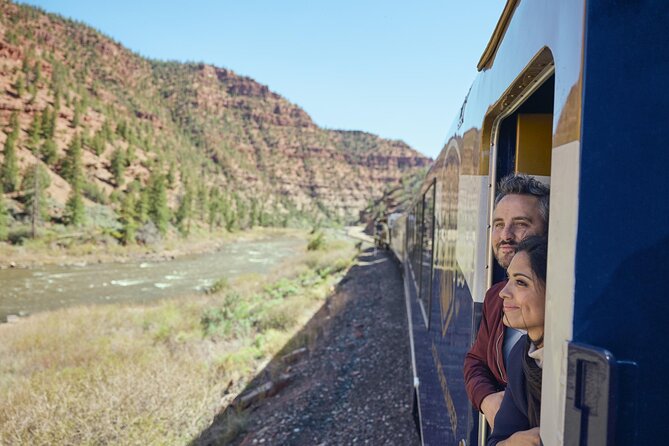
You arrive in Glenwood Springs in the evening and spend the night there. This historic resort town is known for its hot springs, so you may choose to rest at the hotel or enjoy a soak if timing and hotel arrangements allow.
The overnight stop is important for comfort. A rail journey this scenic still requires long hours seated, and splitting it into two days keeps the trip from becoming exhausting. Your luggage is transferred to and from the midpoint accommodation, which means you do not need to haul every bag from train to hotel and back again.
The exact hotel can shape the evening. Hotel Colorado has been praised as a particularly memorable historic property, but the supplied trip details do not guarantee that every departure uses that hotel. Check your booking documents for the named accommodation and its location.
Do not expect a full Glenwood Springs sightseeing program. The town is the overnight base, not a guided evening tour. If you want time at the hot springs or a proper look around town, confirm how much free time you have before adding plans.
Same tracks, a different carriage:
- Key West Conch Train Tour
★ 4.5 · 234 reviews - Fairbanks: Gold Dredge 8 Historic Train Tour
★ 4.7 · 219 reviews - Wild West Day Trip to Virginia City from Tahoe with Train Ride
★ 4.0 · 142 reviews - All-Day Guided Zipline Tour with Train Ride and Lunch in Durango
★ 5.0 · 133 reviews
Day two: from mountain valleys to red rock country
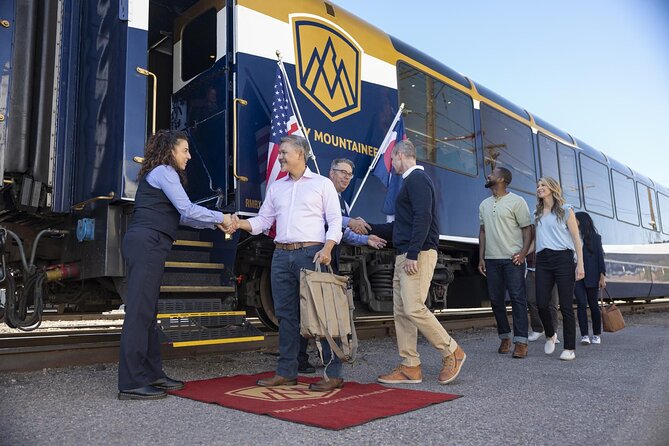
The second morning begins with a two-course hot breakfast made with locally sourced ingredients. As the train heads southwest, the mountain scenery starts to open. You pass New Castle, where the Colorado River supports fishing, rafting, and kayaking, then continue past Parachute Creek and Mount Logan.
De Beque Canyon is a strong early highlight. It runs for about 15 miles and has stair-step cliffs made from layers of sedimentary rock. From the train, you get a clear sense of how water and time cut through the plateau. The formations are less famous than the arches near Moab, but they help explain the geology you will see later.
The route then passes Grand Junction, formed near the meeting point of the Gunnison River and the Grand River, which was the early name for the Colorado River. Fruita follows, surrounded by mesas and known for dinosaur fossils. Fruita also has one of the stranger pieces of local lore in the region: it was home to Mike the Headless Chicken and hosts a festival in his name each May.
These small details are where the onboard storytelling earns its keep. Hosts including Joey, Olivia, Tristan, Lacey, Paul, and others have been praised for mixing local history, odd facts, and route information. The narration gives you something to listen for when the scenery briefly becomes less dramatic.
Red sandstone, old railroad towns, and the approach to Moab
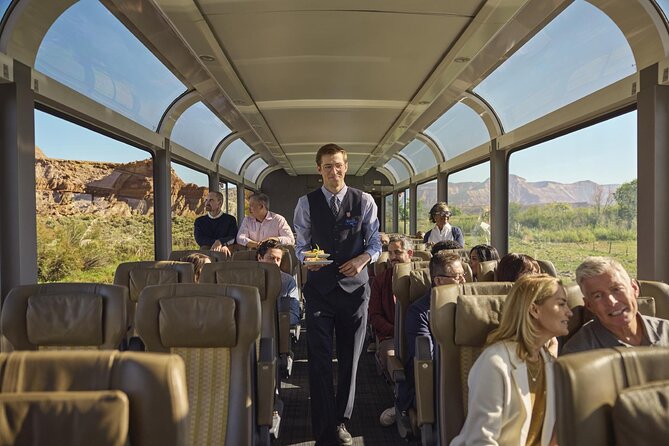
As the train continues into Utah, red sandstone begins to take over. The Colorado River cuts through a roughly 25-mile canyon lined with red rock walls. This section is popular with rafters but is otherwise difficult to reach, giving the train a useful view of a corridor that many road visitors never see.
The old railroad towns of Cisco and Thompson Springs add a human layer to the route. Cisco once served steam locomotives on the Denver and Rio Grande Western Railroad. Interstate 70 and the decline of steam rail travel changed its fortunes. Thompson Springs suffered a similar fate and now has very few buildings, though a small number of residents remain.
These places are not polished attractions. That is exactly why they add something to the journey. You see how roads, railways, water, and changing transport patterns shaped settlement in the West. The quiet remains of the towns contrast sharply with the huge rock formations around them.
Near Moab, the scenery makes its final dramatic change. Red rock formations appear beside the route, and you pass by Arches National Park with the La Sal Mountains in the distance. The La Sals are the second-highest mountain range in Utah, rising sharply beyond the desert. The contrast between snowy or high mountain peaks and warm-colored sandstone is one of the best views of the entire trip.
The train disembarks westbound passengers at the Hoodoo Moab Hotel. Moab itself is the base for Arches, Canyonlands, Capitol Reef, Bryce Canyon, and Zion, but this rail experience does not include visits to those parks. Plan extra nights and separate park transportation if you want more than the arrival view.
What SilverLeaf service is worth to you
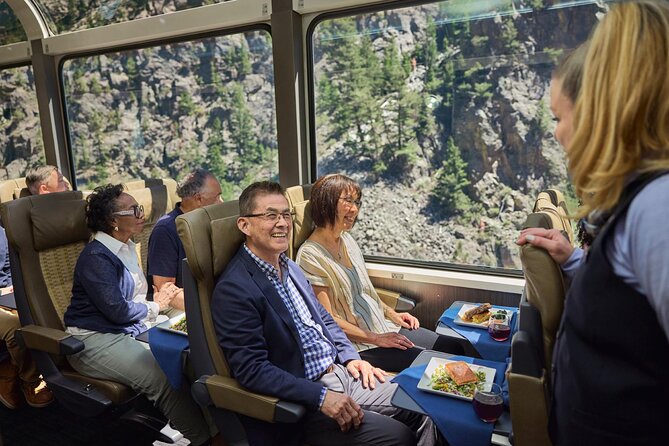
SilverLeaf is built around convenience rather than independence. You stay in your seat while Hosts bring meals, beverages, and snacks. That works well when the train is passing through a narrow canyon and you do not want to miss the view while looking for a dining area.
The cars are described as clean and comfortable, with dome windows that make it easier to see upward as well as sideways. A restroom is available onboard. WiFi is not included, so download maps, books, music, or shows before departure if you need them.
Service is one of the strongest parts of this trip. Specific crew members praised for warmth and attention include Joey, Mike, Carol, Jessica, Olivia, Sophia, Leigh, Tracey, Rae, Alivia, Neal, Evan, and Chris. Names and staffing vary by departure, but the pattern is clear: expect a crew that handles food, drinks, baggage coordination, and storytelling as one combined service.
The small maximum group size listed for the activity is 15 people. Since the train itself is larger than that, this likely refers to the organized tour portion rather than the entire rail car. Confirm the exact arrangement if a small private group is important to you.
Price, timing, and who gets the most value
At $1,723 per person, the cost is substantial. You are paying for more than a train seat: two days of rail travel, meals and drinks onboard, one night in Glenwood Springs, luggage handling, gratuities, Hosts, and the ease of having the route organized for you.
I would compare it with the cost of a rental car, fuel, hotels, meals, and the time required to drive the same general corridor. The train will not always be the cheaper choice, especially if you are traveling as a family. Its value comes from the views, the service, and the chance to enjoy the route without driving.
This suits you best if you:
- Prefer scenery and comfort to a packed sightseeing schedule.
- Want to see the Colorado River canyons without handling the road.
- Enjoy rail travel, onboard meals, and local storytelling.
- Are adding Moab to a larger Colorado and Utah trip.
- Value luggage transfers and a planned overnight stop.
It may not suit you if you want frequent walks, long stops, independent meal choices, or a low-cost transfer between Denver and Moab. You also need to be comfortable with a nonrefundable booking. The activity allows service animals, is near public transportation, and is described as suitable for most participants, but specific mobility arrangements should be confirmed before purchase.
Should you book the Rockies to the Red Rocks train?
Book it if the journey matters as much as the destination. The route gives you river-level canyon views, the Moffat Tunnel, Gore Canyon, De Beque Canyon, old railroad towns, and a memorable red rock approach to Moab. The attentive Hosts and seat service make the long viewing days easy.
Skip it if you mainly need transportation or plan to spend every hour hiking in national parks. You will not tour Arches or Canyonlands from this train. For the right person, though, this is a polished way to see the changing face of the West, from Denver’s foothills to Moab’s sandstone, with very little logistical work on your shoulders.
FAQ
How long is the Denver to Moab train journey?
The experience lasts approximately two days. You travel from Denver to Glenwood Springs on the first day, stay overnight, then continue to Moab on the second day.
Where do I stay overnight?
The overnight stop is in Glenwood Springs, Colorado. One night of accommodation is included, though the supplied details do not guarantee a particular hotel for every departure.
Are meals included?
The trip includes lunch, and the onboard service describes breakfast, lunch, snacks, and drinks. Day two includes a two-course hot breakfast. Confirm the exact meal inclusions for your selected fare before booking.
Does the train stop at Arches National Park?
No. The train passes by Arches National Park near Moab, with views of red rock formations and the La Sal Mountains. A separate visit is needed to explore the park.
Is WiFi available onboard?
WiFi is not included onboard. Restrooms are available on the train.
Where does the journey end in Moab?
For westbound passengers traveling from Denver to Moab, the train disembarks at the Hoodoo Moab Hotel. The supplied meeting-point information also lists the Rocky Mountaineer Moab Guest Centre at 59 South Main Street, so confirm your exact arrival and transfer details before departure.
New on the timetable around the USA
- Virginia City Day Tour From Lake Tahoe with Train Ride★ 4.8 · 19 reviews
- Ventura: Rail Bike Guided Tour with Farm Stand Stop★ 4.1 · 18 reviews
- Winnipesaukee Scenic Railroad★ 4.5 · 7 reviews
- Laughton Glacier Hike and White Pass Rail Adventure★ 5.0 · 12 reviews
- Snoqualmie Fall & Railway Museum 3-Hours (Private Tour)★ 5.0 · 4 reviews
- Grand Canyon Excursion from Sedona with First Class Train Ride★ 4.5 · 47 reviews
- Train Ride Adventure through Mother Natures Giant Redwoods Park★ 4.5 · 9 reviews
- Verde Canyon Rail Day Adventure from Scottsdale or Phoenix★ 5.0 · 4 reviews
Other USA Train Journeys worth a seat
Skunk Train: Pudding Creek Express from Fort Bragg
Read our review →
Wild West Day Trip to Virginia City from Tahoe with Train Ride
Read our review →
All-Day Guided Zipline Tour with Train Ride and Lunch in Durango
Read our review →
Chattanooga: Derailed Trolley Tour and Train Ride
Read our review →
Derailed Adventure – Chattanooga Trolley & Train Combo Tour
Read our review →Lists this ride appears on